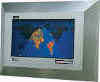
|
||||
|
||||
|








Geochron World Time Indicators
Unique Illuminated World Map/Clock Showing World Time at a Glance
|
||||
|
||||
|
Geochron World Time Indicators
Unique Illuminated World Map/Clock Showing World Time at a Glance
| Contemporary Geochron | Boardroom Geochron | Designer Geochron |
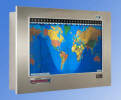 34 1/2" x 22 3/8" x 5" |
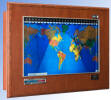 36 1/4" x 24 3/8" x 5" |
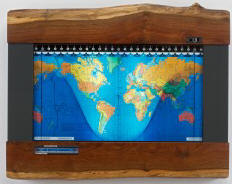 36 1/4" x 24 3/8" x 5" |
| $3,495.00 (free s/h) | $4,595.00 (free s/h) | $4,995.00 (free s/h) |
| Original Geochron | Digital Geochron | |
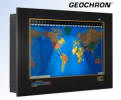 34 1/2" x 22 3/8" x 5" |
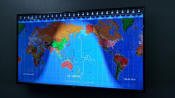 Displayed on TV |
PayPal Credit monthly installments
|
| $2,895.00 (free s/h) | $499.00 (free s/h) | |
Call us toll-free 877-822-9889 or 812-333-2772 for orders/questions Mon.-Sat. 10:00 am-5:30 pm Eastern Standard Time
| WORLD TIME: There are 34 local world time zones and Geochron shows them all - which is much more practical than having a multitude of clocks. |
EASY
- TO - USE: Simply follow the country's/city's time zone up to the timescale at the top of the map to tell the time in that locality. |
FUNCTIONALITY: |
| DAY AND NIGHT: Geochron shows the exact portions of the Earth that are in daylight and those that are in darkness. |
SEASONS: As the seasons change, the light pattern will reflect this throughout a year: See pictures below:
|
PRESTIGIOUS: Due to Geochron's stunning looks it is often used to decorate an office or boardroom and often used in reception areas to impress visitors. |
DATE
AND DAY OF THE WEEK: The days of the week are observed on either
side of the International Dateline. |
SUNRISE AND
SUNSET:
|
|
The Geochron - perhaps best described as a functional wall sculpture, is a dramatic 2-foot-by-3-foot (34 1/4" x 22 1/2" x 4 1/2") global map/chronometer, framed with wood and encased behind glass, whose timepiece is synchronized with the earth's orbit. The principal objective of the Geochron is to provide a device capable of pictorializing, on a flat surface global solar time and its modifications as well as related natural phenomena. The Geochron displays the following: Legal Zone Time, Greenwich mean time, Greenwich apparent time, local apparent time, local mean time, moment of sunrise, moment of sunset, duration of daylight, sun's meridian passage, sun's equation of time, degrees latitude, degrees longitude, the geographic extent of the prevailing day and date. A Brief Introduction to Solar Time, Its Modifications, and Related Facts The basis of daily time measurement is the relationship of the earth's surface to the sun. Thus, when the earth makes one revolution about its axis relative to the sun, it is said to be one day. However, the speed of the earth's travel around the sun varies so that over a period of one year, some days are shorter and others longer, causing the relative zenith, or noon position of the sun to vary accordingly. This is what is measured by a sun dial-"apparent solar time". For time measurement purposes, man has taken the "mean" between the longest and the shortest apparent solar days, divided it into 24 equal hours, and thus had "mean solar time". When our clocks say 12 o'clock "mean time", it does not necessarily indicate that the sun is at its zenith. For the largest part of the year, there is a difference between "mean noon" and " apparent noon", and this difference is called the "equation of time". One's location in longitude within a time zone also affects the relationship between "apparent noon" and "legal zone time noon". the geographic extent of a given day is determined by the position of the international dateline (180 degrees meridian of longitude) relative the "mean sun" or "mean noon". For example, if the international dateline coincides with the "mean sun" (mean noon), half of the earth's surface is today and the other half is tomorrow or yesterday, depending on which half one's position is. thus, there are two different week days and dates at any given moment, except for an instant each day when it is midnight at the dateline. At this point of time, the same day exists around the earth. "Zone time" is, of course, the designated time for a given area measuring, ideally, 15 degrees in longitude, having a standard meridian central to the zone. In practice, however, legal zone boundaries are highly irregular and non-conforming. Further distortion of "ideal" zone time occurs where daylight savings time is used. The time of sunrise and sunset is influenced by one's position in latitude, due to the 23 1/2 degrees tilt of the earth relative to its orbital plane. It also varies due to the changing speed of the earth along its orbit around the sun. For example, at the equator, the time of sunrise and sunset varies 30 minutes over a period of one year, (same as equation of time) while the actual daylight period remains nearly constant. Design Consideration of the Geochron The information shown by Geochron is displayed on a flat surface rather than a globe because only a limited legible area is seen when glancing at a globe. The instrument is normally hung from the wall. To permit recess mounting, its depth is based on the 3- 1/2" width of a standard wall stud. Thus, Geochron can be surface or flush mounted. Both methods are also designed to prevent accidental dropping of the instrument. The length and height of the Geochron are governed by the fact that one inch of longitude on the map is equal to one hour, and that 75 degrees north latitude and 66 1/2 degrees south latitude cover all areas of time telling importance. Geochron's appearance is intended to be simple, devoid of apparent controls and knobs, and its finish is adaptable to prevailing decor. The fluorescent tubes, starters and ballasts used in its internal illumination are accessible and replaceable without dismantling the unit. |
Call us toll-free 877-822-9889 or 812-333-2772 for orders/questions Mon.-Sat. 10:00 am-5:30 pm Eastern Standard Time
|
Home | Products | About Us | Contact Us | Helpful Links | Order, Return & Privacy Policies | Site Map | International Orders |
||||||||||||||
|
|
|||||||||||||
|
Site Map | Privacy Policy | Easy Return/Exchanges | APO/FPO Orders | No Minimum Order + FREE Shipping (contiguous USA) |
||||||||||||||
 Made in United States
 The
Summer Solstice
The
Summer Solstice The
Winter Solstice
The
Winter Solstice The
Spring and Autumn Equinoxes!
The
Spring and Autumn Equinoxes!